What Is a Product Design Studio? And What Does One Actually Do?
Product Design
Is Bigger Than UI/UX.
A product design studio turns ideas, requirements, and complex workflows into market-ready digital products. This guide explains what the studio does, how it differs from other partners, and when hiring one makes sense.

What a Product Design Studio Actually Does
The phrase product design studio appears everywhere now. In the early 2000s, it was adopted by specialized agencies in major design and technology centers such as San Francisco and London. More recently, UI/UX design studios have embraced the term en masse.
A product design studio helps turn an idea into a market-ready product. For physical products, that may include industrial design, 3D prototyping, and manufacturing preparation. For digital products, it typically spans product strategy, user research, UX and UI design, prototyping, design systems, and engineering handoff across SaaS platforms, mobile apps, enterprise software, and other digital experiences.
But product design is not simply another name for visual design. A genuine product design studio helps determine how a digital product should work, how users should move through it, how the interface should respond, how complex information should be organized, and how the entire experience can be delivered to engineering in a form that can actually be built.
That work may include user research, product strategy, information architecture, user flows, wireframes, interaction design, interface design, prototyping, usability testing, design systems, and engineering handoff.
The interface is part of the product. It is not the entirety of the product.
What Is a Product Design Studio?
A product design studio is a specialized team that helps companies define, design, improve, and scale digital products.
Those products may include
SaaS Platforms
Subscription software built around recurring workflows, user roles, and continuous product growth.
Enterprise Applications
Complex internal systems supporting large organizations, permissions, data, and operational workflows.
Desktop Software
Installed applications designed for sustained, high-value work on Windows or macOS.
Mobile Applications
iOS and Android experiences shaped around touch, context, and smaller screens.
Fintech and Payment Products
Financial interfaces where trust, verification, transactions, and error prevention matter.
Healthcare Platforms
Healthtech products balancing clinical workflows, privacy, accessibility, and sensitive information.
Cybersecurity Software
Security products that must clarify risk, evidence, severity, and the next action.
Customer and Employee Portals
Role-based environments for accessing services, information, tools, and support.
Dashboards and Data-Heavy Systems
Interfaces that organize complex data around decisions, priorities, and action.
Connected-Device Interfaces
Experiences connecting software to hardware, kiosks, wearables, or other devices.
Emerging AI and Agentic Products
Interfaces for AI systems that recommend, adapt, or act with varying levels of autonomy.
The studio's responsibility extends beyond deciding what a product should look like. It must also understand what the product needs to accomplish, who will use it, which workflows matter most, what technical or regulatory constraints exist, and how the experience should behave across different users, devices, permissions, states, and edge cases. A product design studio therefore operates where business strategy, user needs, technology, and visual communication meet.
Product Design Is Bigger Than UI/UX
UI and UX design are essential parts of product design. User experience design focuses on how people understand, navigate, and complete tasks within a product. User interface design focuses on the visual and interactive system through which that experience is delivered. Product design includes both while placing them inside a broader product context.
A product design studio may also consider
Which Problem the Product Is Solving
Define the user, business, and operational problem before deciding what to build.
Which Features Belong in the Initial Release
Decide which capabilities belong in the first credible version and which can wait.
How Users Reach Value Quickly
Reduce the time between entering the product and reaching a meaningful outcome.
How Workflows Change by Role or Permission
Shape information and actions around different users, responsibilities, and access levels.
How Complex Information Should Be Prioritized
Organize content so the most important information is understood and acted on first.
How Product States Are Handled
Design empty, loading, error, success, and recovery states as part of the experience.
How the Experience Scales
Create structures and systems that remain coherent as features and workflows are added.
How Design Affects Product Outcomes
Connect design decisions to activation, adoption, retention, and support.
How Engineering Reproduces the Experience
Document components, behavior, states, and specifications so the approved product can be built accurately.
Product design does not replace UI/UX design. It connects UI/UX design to the broader product lifecycle.
Common Question
Is product design the same as UI/UX design?
No. UI and UX design are central parts of product design, but product design places them inside a broader process that also considers product strategy, feature priorities, technical constraints, business objectives, validation, scalability, and engineering implementation.

What Services Does a Product Design Studio Provide?
Not every studio offers the same capabilities, but a comprehensive product design engagement commonly includes several connected disciplines.
Product Discovery and Strategy
Before screens are designed, the team needs to understand the product, its users, the business model, the market, and the constraints surrounding the work. Discovery may include stakeholder interviews, product reviews, competitive research, technical discussions, existing analytics, support data, and evaluation of current user behavior. The goal is not to produce a large strategy document that nobody uses. The goal is to establish enough clarity to make stronger design decisions.
User Research
Research helps replace assumptions with evidence. Depending on the product and engagement, that may include user interviews, contextual research, usability testing, workflow analysis, surveys, support-ticket reviews, or examination of product analytics. Research should answer practical questions. Where are the primary user pain points? Which tasks matter most? What terminology do users understand? What information is missing? What friction is causing abandonment, errors, or support requests?
Information Architecture
Complex products contain large amounts of information, functionality, and navigation. Information architecture determines how those elements are grouped, labeled, prioritized, and made accessible. This becomes especially important in enterprise software, where a single platform may contain dozens of modules, user roles, administrative tools, reporting areas, and deeply nested workflows.
User Flows and Journey Mapping
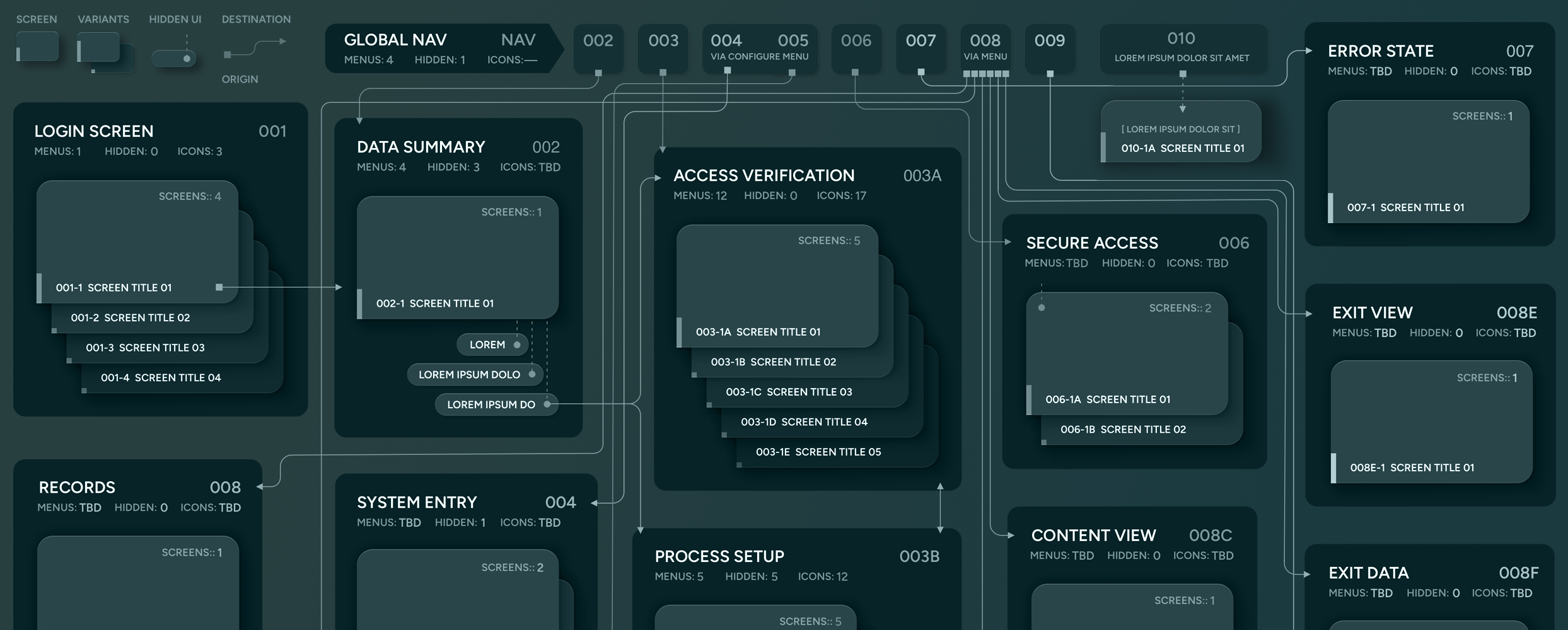
User flows show how people move through a task. They expose missing decisions, unnecessary steps, conflicting states, and moments where the product may fail to provide the information users need. A strong flow considers more than the ideal path. It also accounts for interruptions, validation problems, permission restrictions, failed transactions, empty states, and recovery.
A Look at a Real User Flow
Wireframing and Prototyping
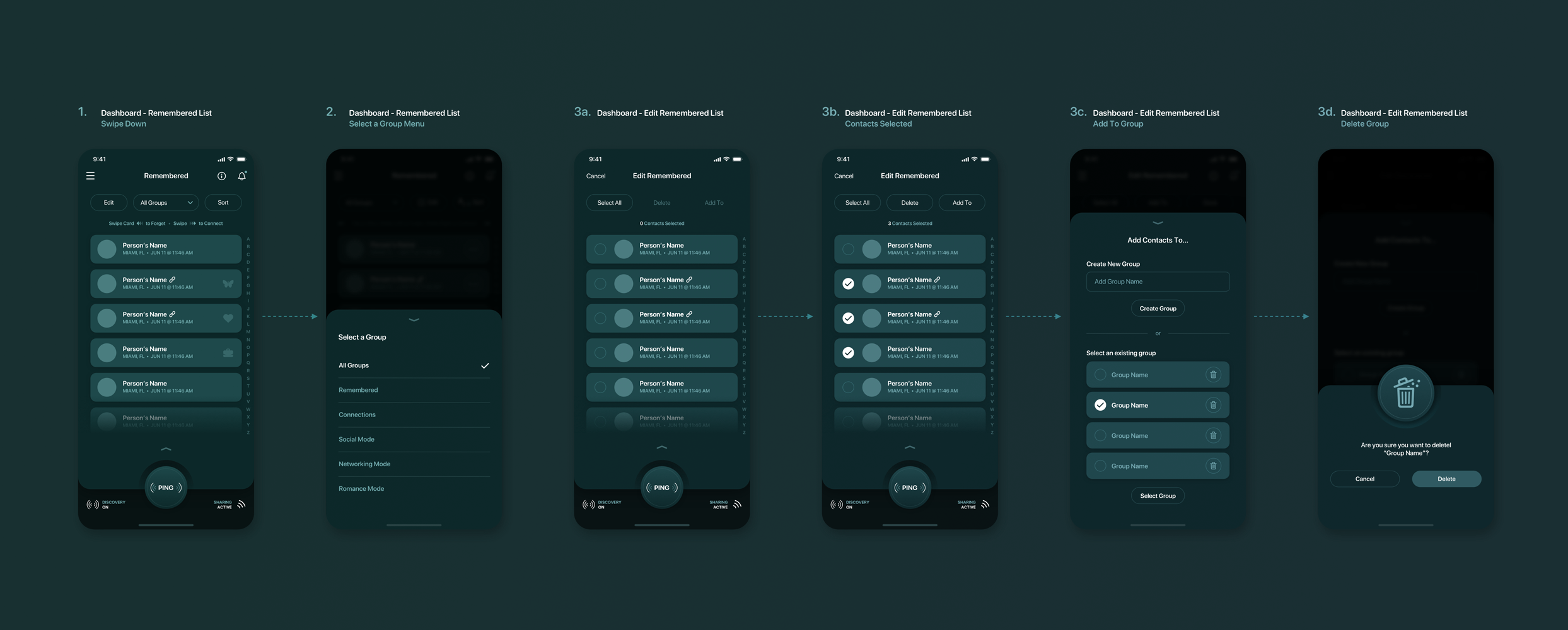
Wireframes establish structure before the visual system is fully developed. They help teams evaluate hierarchy, navigation, workflows, content placement, and functional requirements without becoming distracted by visual details too early. Interactive prototypes then allow teams to experience important flows before development begins. That makes it possible to test assumptions, identify gaps, and improve the product while changes are still relatively inexpensive.
From Wireframe to Interactive Prototype
Interaction and Interface Design
This is where product behavior and visual design come together. The studio defines how controls respond, how information changes, how transitions guide attention, how states communicate progress, and how the interface expresses the company's product and brand position. Strong interface design is not decoration. It creates hierarchy, improves comprehension, reduces cognitive load, and helps users act with greater confidence.
Design Systems
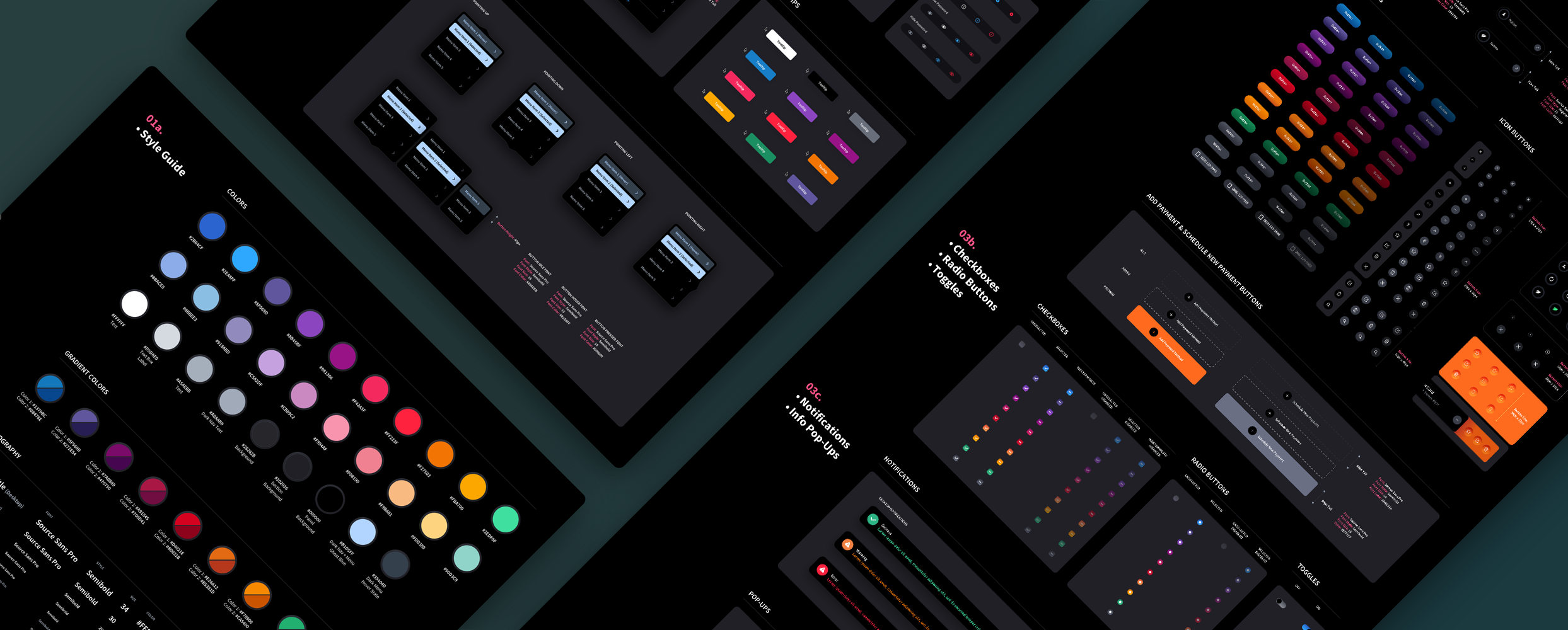
A design system gives a product a reusable visual and functional language. It may include typography, color, spacing, controls, forms, tables, navigation, alerts, cards, data visualizations, interaction patterns, accessibility guidance, and documented component behavior. Without a design system, products often become less consistent with every new release. With one, product and engineering teams gain a shared foundation that can improve speed, consistency, and quality across the platform.
A Look Inside a Real Design System
Engineering Handoff
A product design engagement is not successful merely because the approved screens look good. The work must be structured so developers can build it. That means accounting for responsive behavior, component states, field validation, edge cases, spacing, interactions, assets, and technical constraints. The best product design studios remain engaged through handoff and implementation rather than throwing design files over the wall and disappearing.
Common Question
What services should a product design studio provide?
The right mix depends on the product, but a complete engagement may include discovery, user research, information architecture, user flows, wireframes, prototyping, interaction and interface design, usability testing, design systems, and engineering handoff. The important point is that these activities work together rather than being sold as disconnected deliverables.
How Is a Product Design Studio Different From Other Partners?
The terminology can become confusing because several types of companies may participate in a digital-product initiative.
Product Design Studio Versus Branding Agency
A branding agency focuses primarily on identity, positioning, messaging, and brand expression. A product design studio applies brand thinking inside a functional product experience while also solving workflows, usability, interaction, architecture, and system behavior. Some studios can do both, but the disciplines are not interchangeable. A beautiful identity does not automatically produce an effective software product.
Product Design Studio Versus Development Company
A development company engineers and deploys the software. A product design studio determines how the experience should work and provides the product definition, workflows, interface system, prototypes, and specifications required for implementation. Some development firms have strong internal design teams. Others treat design as a supporting service. Companies should evaluate the actual quality and depth of the design work rather than assuming development and product design are equally represented.
Product Design Studio Versus an Internal Design Team
An internal team brings long-term product knowledge and daily access to stakeholders. A studio brings an outside perspective, specialized expertise, and experience gained from solving different product problems across multiple organizations and industries. The two models can also work together. A product design studio may lead a redesign, provide expertise the internal team lacks, accelerate a critical initiative, establish a design system, or supply fractional design capacity during periods of high demand.
Common Question
What is the difference between a product design studio and a development company?
A product design studio defines how the product should work and prepares the experience for implementation. A development company engineers and deploys the software. Some firms offer both, but companies should confirm which team owns product strategy, UX, UI, prototyping, and design quality.
Product Design From Scratch: The Intel Graphics and Media Control Panel
Product design is sometimes described as though it emerged recently. The terminology may have evolved, but the work itself has existed for decades.
In late 2007, Intel engaged The Skins Factory to design a completely new Windows desktop application called the Intel Graphics & Media Control Panel. The project began with a 218-page feature-detail document. Before visual design started, our team worked through the product requirements and created hundreds of pages of schematics covering the application's functionality and structure.
Intel Product Schematics
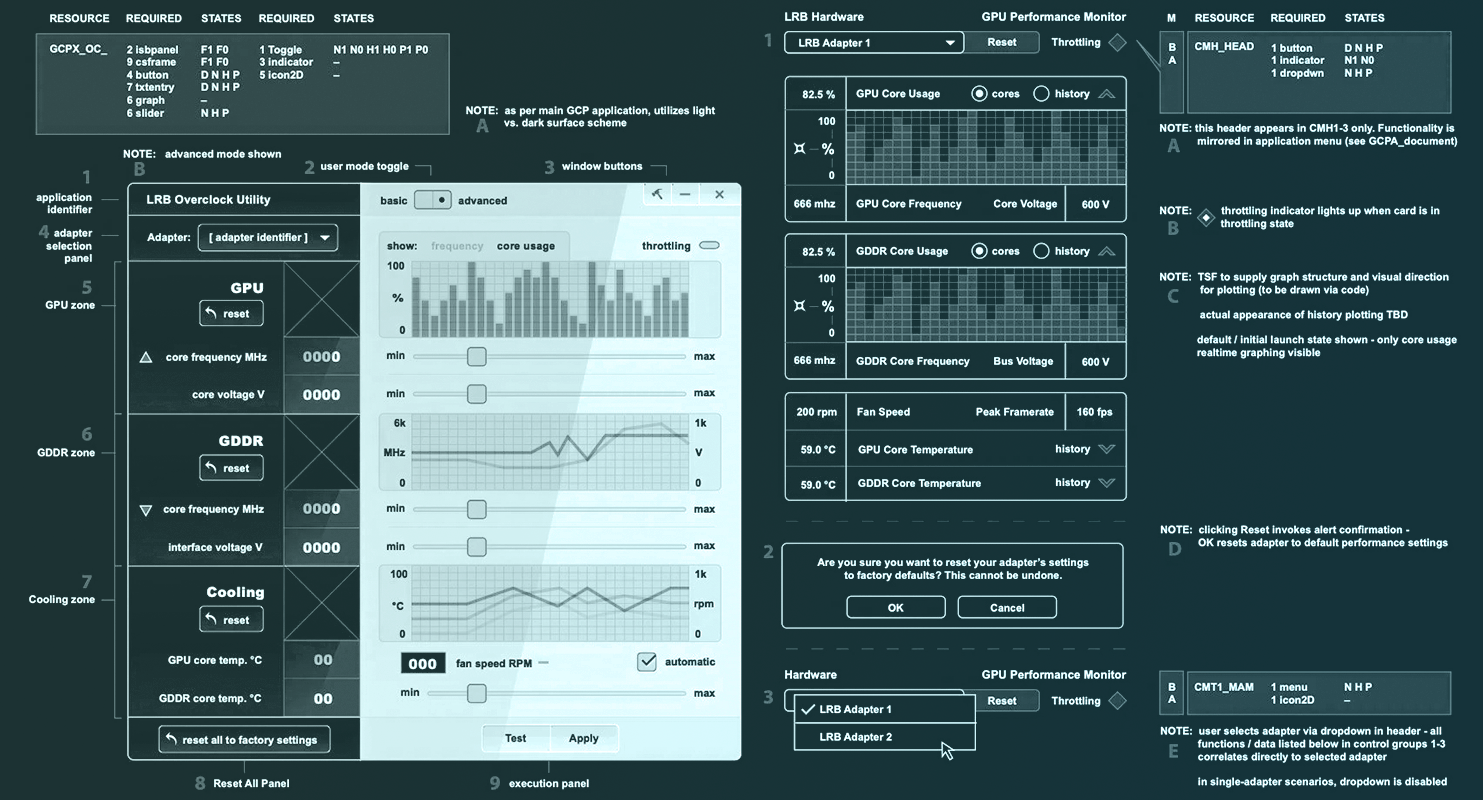
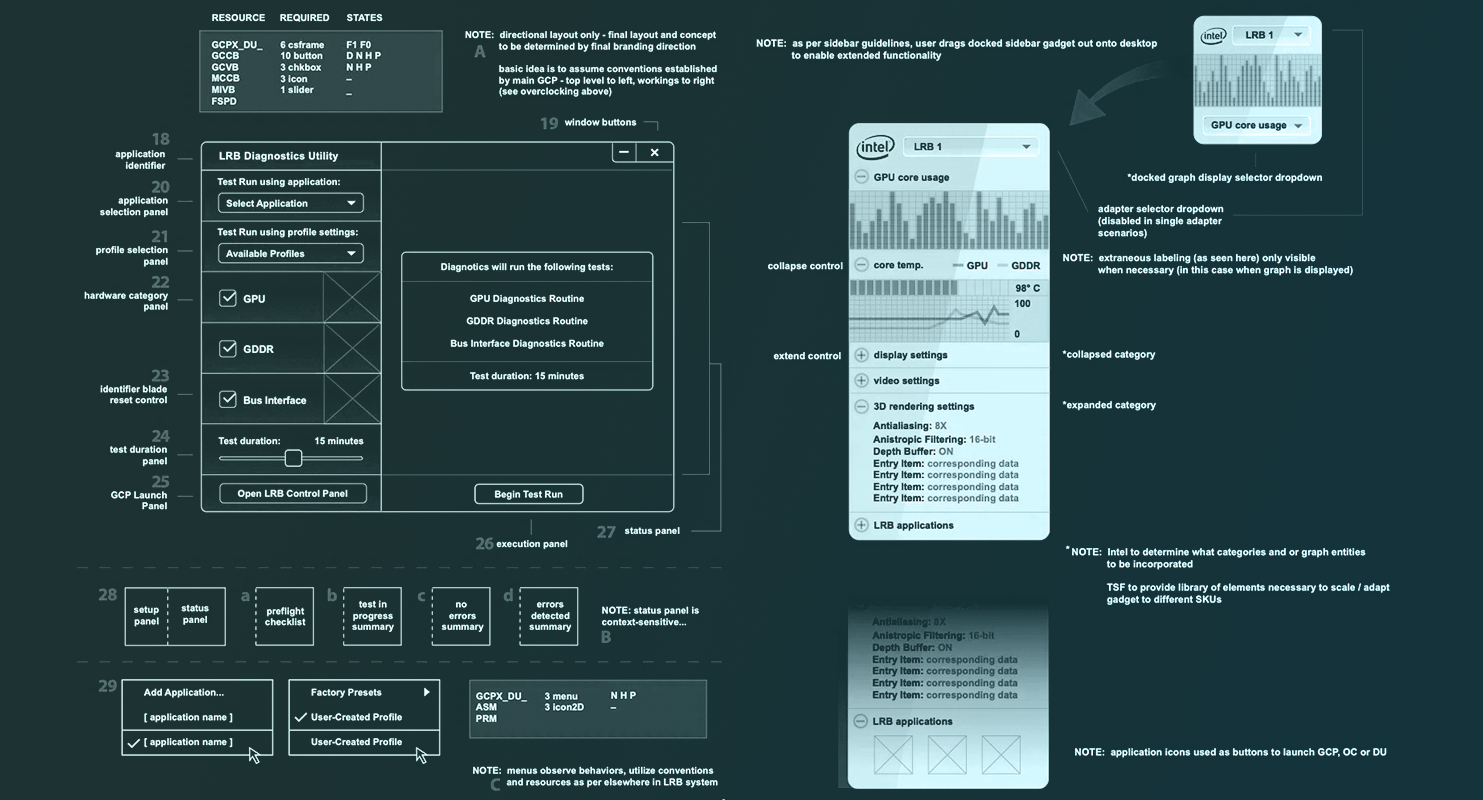
That first phase took more than a year. Only after the functional foundation had been established did the project move into interaction and visual design. The complete engagement took approximately 17 months across a two-year period and included the application experience, a visual design system, interactive behavior, custom iconography, and a companion Windows Vista Sidebar Gadget.
Intel's direction to the team was simple: Ignore what came before. Reimagine what is possible.
That is product design. The assignment was not to reskin an existing interface or decorate a predetermined layout. It was to interpret an enormous set of functional requirements, organize them into a usable product, prototype the experience, establish a new interaction model, and create the final interface system from the ground up.
The work eventually shipped across more than one billion PCs worldwide. The visual language reflects the period in which it was created, but the process remains directly relevant today.
The product design process
Understand the Product
Work through requirements, users, business needs, technical constraints, and the complete feature set.
Establish the Architecture
Organize functionality, navigation, roles, information, and system structure before visual design begins.
Prototype the Workflows
Turn the architecture into testable flows that expose missing decisions, states, and edge cases.
Define the Interactions
Specify how controls respond, states change, feedback appears, and users move through the product.
Create the Visual System
Build the interface language, components, iconography, hierarchy, and design-system foundation.
Prepare the Product to Be Built
Document behavior, states, assets, and specifications so engineering can implement the approved experience.

The tools change.
The discipline does not.
When Should a Company Hire a Product Design Studio?
There is no single stage at which outside product-design support becomes appropriate.
It Is Designing a New Product
Founders and funded startups often have a strong product concept but need experienced help turning that concept into a credible, testable, and buildable product.
A studio like The Skins Factory can help define the initial release, establish the primary workflows, build a prototype, and create an interface system that is ready for engineering and investment conversations.
The Existing Product Has Become Difficult to Use
As software grows, new features are often added without reconsidering the overall experience. In the industry, we call this “bloat.” Navigation becomes crowded. Workflows become inconsistent. Different parts of the product begin behaving like separate applications.
The Skins Factory was tasked by ACI Worldwide to fix this exact problem. They wanted to overhaul the main navigation drop-downs to make them more manageable. Our team redefined how the navigation system operated by making the experience customizable. Users could move sub-navigation sections and hide unwanted entries, improving productivity while giving each user more control over the interface.
A product design studio can audit the current experience, identify the most damaging problems, and establish a redesign strategy based on evidence rather than assumptions.
The Product No Longer Reflects the Company
A business may mature while its product still looks and behaves like an early-stage release. That disconnect can affect credibility, sales, adoption, and customer confidence. Product modernization aligns the experience with the company’s current market position without discarding functionality users still depend on.
The Internal Team Lacks Specialized Expertise
A capable internal team may still need help with enterprise workflows, regulated products, complex dashboards, accessibility, onboarding, design systems, or legacy modernization. A studio can provide that expertise without requiring the company to build every specialty internally.
The Company Needs Flexible Senior Support
Not every organization needs another permanent hire. Fractional product design allows companies to access senior design expertise and production support without adding full-time headcount or paying for unused capacity during slower periods.
Common Question
When should a company hire a product design studio?
A company should consider a studio when it is defining a new product, redesigning an experience users struggle with, modernizing a product that no longer reflects the business, filling a specialized expertise gap, or adding senior design capacity without another permanent hire.
How to Evaluate a Product Design Studio
A studio's own description of its capabilities should never be the only evidence considered.
Five things to evaluate
Start with the work
Does the portfolio demonstrate an ability to solve products with similar complexity? Does it include real software, or primarily marketing websites? Can the studio explain the product problem, not only the visual result?
Examine the process
A credible studio should be able to explain how it moves from discovery through architecture, flows, prototypes, visual design, testing, design systems, and engineering handoff.
Ask who will actually work on the project
In some firms, the senior people lead the sales process while a different and more junior team performs the work. The structure should be clear before the engagement begins.
Evaluate independent reviews
Client feedback can reveal how the studio communicates, handles difficult decisions, manages scope, responds to feedback, and supports implementation.
Look for judgment
The right partner should not agree with every assumption placed in front of it. A product design studio is being hired to improve the outcome, which sometimes requires challenging the original direction and recommending a stronger one.

Why Industry Experience Matters
All digital products share certain usability principles. But products in regulated, high-risk, or operationally complex industries carry additional requirements.
The constraints change by industry
Fintech and digital banking
Products must account for trust, verification, transaction states, reversibility, and financial consequences.
Healthcare and healthtech
Products must balance clarity, privacy, accessibility, clinical workflows, and sensitive information.
Cybersecurity
Products must present risk, severity, evidence, and recommended action without overwhelming the user.
Enterprise SaaS
Platforms may include complex permissions, large datasets, multiple roles, legacy dependencies, and workflows that vary across departments or organizations.
A studio does not need to have designed the exact same product before. It should, however, demonstrate that it understands complexity and knows how to work through it systematically.
Common Question
Does industry experience matter when choosing a product design studio?
Yes, especially in regulated or operationally complex products. A studio does not need to have designed the exact same product, but it should understand the constraints, failure states, permissions, data density, compliance requirements, and user consequences that shape the experience.
How The Skins Factory Approaches Product Design
The Skins Factory has designed complex digital products for more than 25 years. Our work spans enterprise SaaS, fintech and digital banking, healthcare, cybersecurity, desktop software, mobile applications, dashboards, connected experiences, and large-scale legacy modernization.
We approach product design as a connected process rather than a collection of disconnected deliverables. That means understanding the product before styling it and working through workflows before finalizing screens.
It means considering edge cases, failure states, accessibility, technical constraints, and engineering realities while the experience is being designed. It also means recognizing that usability and visual quality are not opposing goals. A product should be understandable, efficient, and technically realistic. It should also look extraordinary. The strongest products do both.
Common Questions About Product Design Studios
What is the difference between a product designer and a UI/UX designer?
The roles often overlap. A UI/UX designer may focus primarily on user flows, usability, interactions, and interface design. A product designer may also participate in product definition, feature prioritization, validation, business decisions, and the broader product lifecycle. Titles vary, so companies should evaluate actual capabilities rather than relying on the label alone.
When should a startup hire a product design studio?
A startup should consider hiring a product design studio when it needs to turn an idea into a credible MVP, validate workflows before development, improve an early product, prepare for funding, establish a design system, or access senior product expertise without immediately building a full internal team.
Can a product design studio redesign existing enterprise software?
Yes. Product design studios frequently redesign legacy and enterprise software. The work may involve UX auditing, user research, workflow simplification, information architecture, visual modernization, design-system creation, prototyping, and a phased transition that preserves essential functionality for existing users.
How long does a product design engagement take?
The timeline depends on product complexity, scope, research requirements, stakeholder availability, and the number of workflows and screens involved. A focused prototype may take several weeks, while a complex enterprise platform or ground-up product initiative may require several months or a phased engagement.
How much does it cost to hire a product design studio?
Cost depends on scope, complexity, research depth, the number of workflows and platforms, and whether the engagement covers a focused prototype, a complete product, or an ongoing design relationship. Companies should compare the proposed team, process, deliverables, and senior involvement rather than judging proposals by price alone.
Can a product design studio work with an internal product or design team?
Yes. A studio can lead a major initiative, work alongside an internal team, provide specialized expertise, establish a design system, increase production capacity, or take ownership of work the internal team does not have the time or experience to handle.
What should a company look for when choosing a product design studio?
Look for relevant portfolio work, senior team involvement, a clear process, strong product judgment, complex workflow experience, design-system capabilities, disciplined engineering handoff, transparent communication, and independent client reviews.
What happens after the product design phase is complete?
The studio should deliver organized, developer-ready design files, documented components and states, interaction guidance, assets, and any agreed design-system documentation. Strong teams also remain available during implementation to answer questions and protect the quality of the approved experience.

Product Design Services, Specialties, and Related Reading
UI/UX Services
View Specialty Pages
Additional Reading
Designing a new product
or rethinking an existing one?
The Skins Factory can turn an idea, requirement set, or early concept into a credible product experience ready for prototyping and engineering.
Our user interface and user experience designers can improve complex software without discarding the workflows, business logic, and user knowledge the existing product still needs.
We offer Design-as-a-Service. Add experienced product-design capacity without another permanent hire or paying for idle internal capacity. Limited engagements welcome.
Turn product requirements into an experience users understand and engineering teams can build.
Whether you are starting with an idea, modernizing a complex platform, or supporting an internal product team, The Skins Factory can help define, design, prototype, and prepare the experience for implementation.Have a project in mind? Let's talk.
Thank you for reaching out.
We will be in touch within one business day.
The Definitive Guide
The UI/UX Design Guide: How Great Digital Products Actually Get Designed

The Definitive Guide
The Fintech UI/UX Design Guide: How Great Financial Products Actually Get Designed

About Jeff Schader
Jeff Schader is the founder and CEO of The Skins Factory, a UI/UX design studio he started in 2000, based in the Miami/Fort Lauderdale area. He has designed software for some of the biggest names in tech and entertainment, including Microsoft, Disney, the NFL, Bank of America, and Intel, along with SaaS, fintech, healthcare, cybersecurity, and enterprise platforms. Jeff runs The Skins Factory lean and stays hands-on across client work, strategy, and design. He writes about UI/UX, AI interfaces, and what actually makes software usable.
Have a project in mind? Schedule a 30-minute call with Jeff. Jeff also publishes The Product Design Insider on Substack.