Journey to the World of Tomorrow: Part 3
Reimagining the Design & Technology of the American Mid-Century Space Program
BY JEFF SCHADER
Mid-century design, with its captivating retro-futuristic allure, epitomizes the fusion of modernity and futurism prevalent from the 1940s to the 1960s. This aesthetic ethos celebrates sleek lines, organic contours, and an unwavering sense of optimism towards tomorrow. Vibrant hues, innovative materials, and echoes of the atomic and space ages comprise its distinctive lexicon. The essence of mid-century retro-futuristic design lies in crafting visually arresting spaces that honor the design ethos of yesteryears while projecting a vision of the future. By skillfully weaving these elements together, we conjure a design narrative that not only captivates but also nostalgically reminisces the spirit of the American mid-20th century.
This Generative AI Art Series asks the question (and answers)… What if the futurists, the science fiction writers & artists of the American mid-century period saw their dreams materialize into reality much sooner than our own reality? What might that futuristic past look like? In this alternate American timeline, America's technological progress unfolds at a far quicker pace compared to our own reality. It's a reality where America & the world avoided involvement in two World Wars, but still embraced the atomic age, spurred by human curiosity to venture into our galaxy and beyond.
In Part 3 of this 3-Part Generative AI Artwork Series, explores The Exploration of Tomorrow: Life on the Moon, as we view rocket ships, space stations, the construction of the first American lunar colony, and all manner of buildings, robots and vehicles meant for the lunar surface.
◆◆◆
This generative AI artwork collection aims to capture the essence of mid-century Americana, it’s optimism for the future and transport us back to the mid-century America where they dared to dream of the future and made it happen. We’ve blended the 1940s thru 1960s visual design images throughout this Alternate Timeline Design Series, as we encompass three decades of the American mid-century era. Now, let’s transport back to “The World of Tomorrow" and venture into a somewhat different American past...
The Rocket Ships of Tomorrow
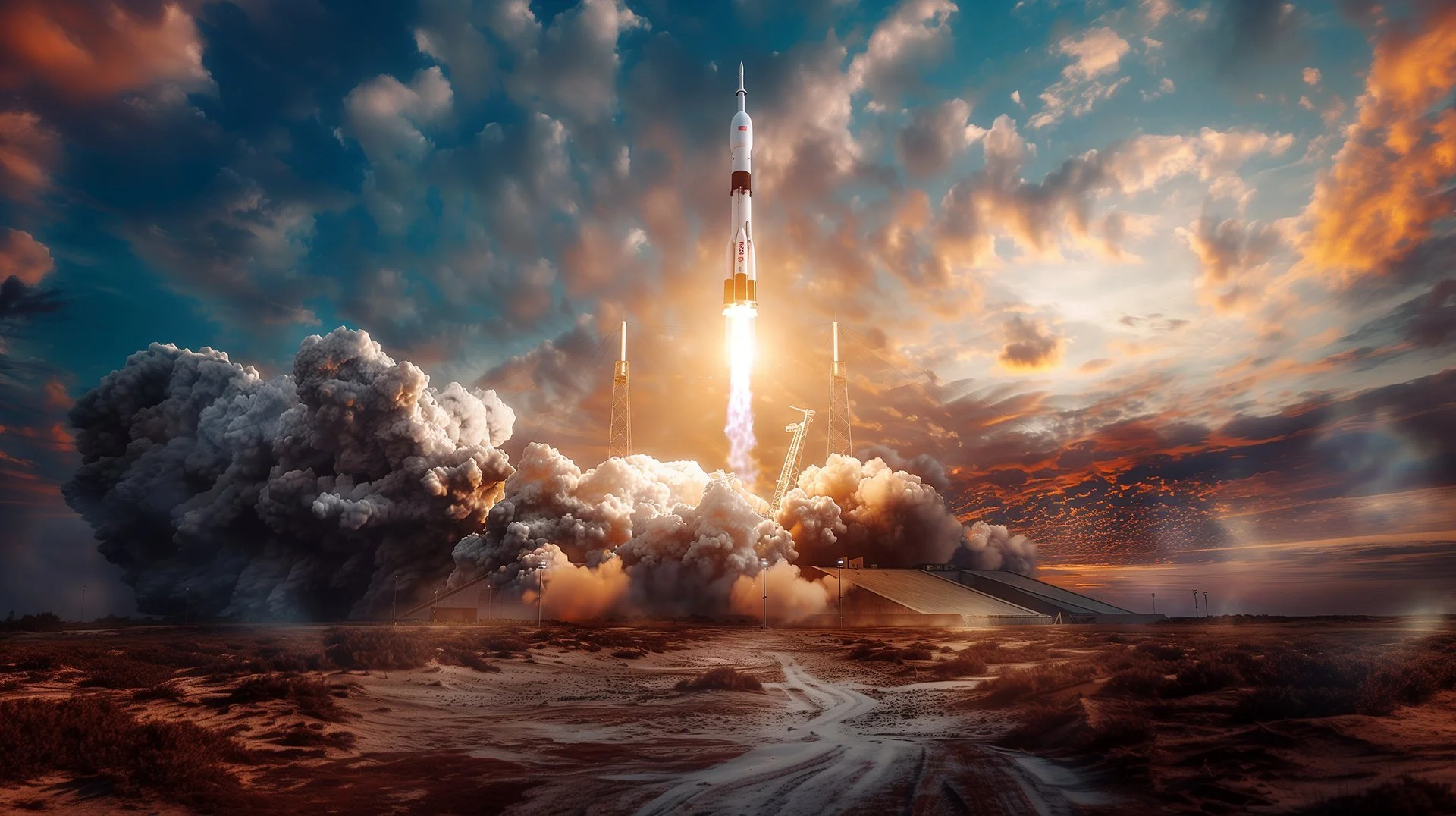
LUNAR CARGO ROCKET SHIPS
The Athena Rocket Program: Early-1940s
The Athena missions I thru VI carried the first building supplies and construction astronauts to the first American lunar colony. The payloads carried by these rockets were not mere scientific instruments or exploratory probes, but rather the raw materials necessary for the establishment of a permanent, American lunar outpost. Giant modules containing prefabricated habitats, inflatable domes, and sturdy construction equipment are carefully loaded into the cargo bays, each item meticulously designed to withstand the harsh lunar environment and provide the foundation for human habitation. They were a testament to the power of American imagination, innovation, and the relentless pursuit of the unknown.


The Ares Rocket Program: Late-1940s
During the 1940s, American rocket technology grew by leaps and bounds under the watchful gaze of scientists, engineers, and visionaries. The Ares moon rockets are marvels of engineering, towering behemoths of metal and flame, designed to carry vast quantities of building supplies to the lunar colony. Their sleek, streamlined forms evoke the imagery of classic sci-fi spacecraft, with gleaming exteriors. Loaded with an array of building supplies ranging from modular habitats to advanced construction equipment, each Ares moon rocket carries the hopes and dreams of a generation. Prefabricated structures, inflatable domes, and state-of-the-art machinery are carefully stowed within the cargo holds, ready to be deployed upon arrival at the lunar surface.


LUNAR COLONY TRANSPORT ROCKET SHIPS
The Hermes Rocket Program: Early to Mid-1950s
The Hermes rockets were marvels of engineering, incorporating advanced propulsion systems that allowed for efficient travel between Earth and the Moon. Utilizing a combination of chemical and fusion propulsion, the Hermes rockets could carry large payloads while ensuring the safety and comfort of passengers. Their reusable design was a key feature, significantly reducing the cost of lunar colonization efforts. Subsequent missions expanded the colony, transporting more colonists, habitats, life support systems, and scientific equipment. The first colony was established in one of the Moon's polar regions, taking advantage of perpetual sunlight for solar power and nearby ice deposits for water.


The Zeus Rocket Program: Mid to Late-1950s
The Zeus Rocket Program was Initiated to meet the logistical demands of supplying the burgeoning lunar colony in the mid to late-1950s and transporting large groups of lunar colonists. The Zeus rockets stood as the largest and most powerful ever constructed when they were built. These towering behemoths of engineering prowess are designed to ferry vast quantities of supplies, equipment, and personnel between Earth and the moon, ensuring the sustainability and expansion of American lunar colonies. Equipped with cutting-edge hybrid solid fuel and fusion propulsion systems, the Zeus rockets can make the Earth-to-moon journey with unprecedented efficiency, dramatically reducing transit times and increasing payload capacities. They were the backbone of the interplanetary supply chain in the mid to late-1950s.


PRIVATE MOON SHUTTLES
Private moon shuttle services are at the heart of this new era, offering regular flights to and from the Earth. These companies have revolutionized space travel by making it safer, more affordable, and more accessible. They operate a fleet of reusable spacecraft, designed for efficiency and comfort, reducing the cost of lunar travel. Booking a trip to the lunar colony is as easy as planning a vacation on Earth. Passengers can choose from various travel packages, ranging from basic economy seats to luxurious private cabins. Itineraries include not just the flight but also accommodation in the colony, lunar surface excursions, and activities like low-gravity sports and moon surface tours.
The two largest American private moon shuttles companies are MoonQuest Transports and Celestial Shuttles. Let’s take a look at their rockets:
MoonQuest Transports: Early-1960s Models


Celestial Shuttles: Early-1960s Models


The Space Vehicles of Tomorrow
SPACE STATIONS
Moon exploration and habitation takes a significant leap forward with the establishment of the NASA Helios Nexus Space Station Program, which produced state-of-the-art space stations strategically positioned at the Lagrange Point between Earth and the Moon. This unique position allows the Helios Nexus stations to serve multiple pivotal roles. As a way station, the Helios Nexus stations serve as a critical stopover point for missions traveling to and from the Moon. They offers a place for astronauts to rest and regroup during the long journey, significantly reducing the risks and costs associated with direct trips. The stations also provide an opportunity for crews to conduct final checks and preparations, ensuring that both the spacecraft and its occupants are in optimal condition before proceeding to the lunar surface or back to Earth. The Helios Nexus stations also act as supply depots, storing essential supplies and equipment for lunar missions and potential deep space ventures. This includes everything from spare parts and tools to food, water, and oxygen. Having centralized depots reduces the need for spacecraft to carry all their supplies from Earth, allowing for larger payloads. The stations also have medical facilities capable of addressing a wide range of health issues, alongside repair docks for damaged spacecraft. They are a critical asset for ensuring the safety and well-being of all personnel involved in lunar colonization and beyond.
Helios Nexus Space I: Late-1950s


Helios Nexus Space II: Mid-1960s


Helios Nexus Space III: Late-1960s


PLANETARY DEFENSE satelliteS
The latter part of the 1960s saw the United States Star Force deploying the Sentinels, cutting-edge planetary defense satellites orbiting the Moon, designed to detect, intercept, and neutralize potential asteroid threats before they can pose any danger to lunar colonies or Earth. The Sentinels are equipped with a high-energy pulse cannon, a revolutionary weapon capable of emitting concentrated bursts of plasma energy with precision accuracy over vast distances. This cannon harnesses the power of nuclear fusion, converting it into a focused energy beam that can vaporize incoming asteroids, or alter their trajectory, effectively neutralizing the threat they pose. To power its sophisticated systems and weapons, the Sentinel utilizes a compact nuclear fusion reactor, providing an almost limitless source of energy. This reactor not only powers the pulse cannon but also supports the satellite's propulsion system, which employs ion thrusters for precise, fuel-efficient movement in space.


Constructing the First Lunar Colony
MONS HADLEY DELTA COLONY
The mid-1940s marked a pivotal era where humanity, driven by technological prowess and the spirit of exploration, embarked on establishing the first colonies on the Moon. At the heart of this endeavor was the innovative use of lunar regolith, the Moon's soil, which proved to be a game-changer in off-world construction. The lunar regolith, abundant on the Moon's surface, was a critical resource, offering a sustainable and cost-effective building material. Scientists and engineers on Earth had developed specialized processes to refine this regolith into a versatile construction material. This material could be used directly in building structures, habitats, and protective domes, significantly reducing the reliance on construction supplies ferried from Earth.
The first colony was built into Mons Hadley Delta. Three entrances dubbed The Trinity, were constructed into the mountain range, as astronauts and construction robots burrowed deep into the mountains and underground.
The Trinity Entrances — Construction Sites: Mid-1940s


The Trinity Facilities: Early-1940s
To house the thousands of construction workers, engineers, colony personnel, scientists and others, living and storage supply structures were erected.


Life on the Moon
Lunar Colonies
Capital City — Shackleton Crater: Early-1950s
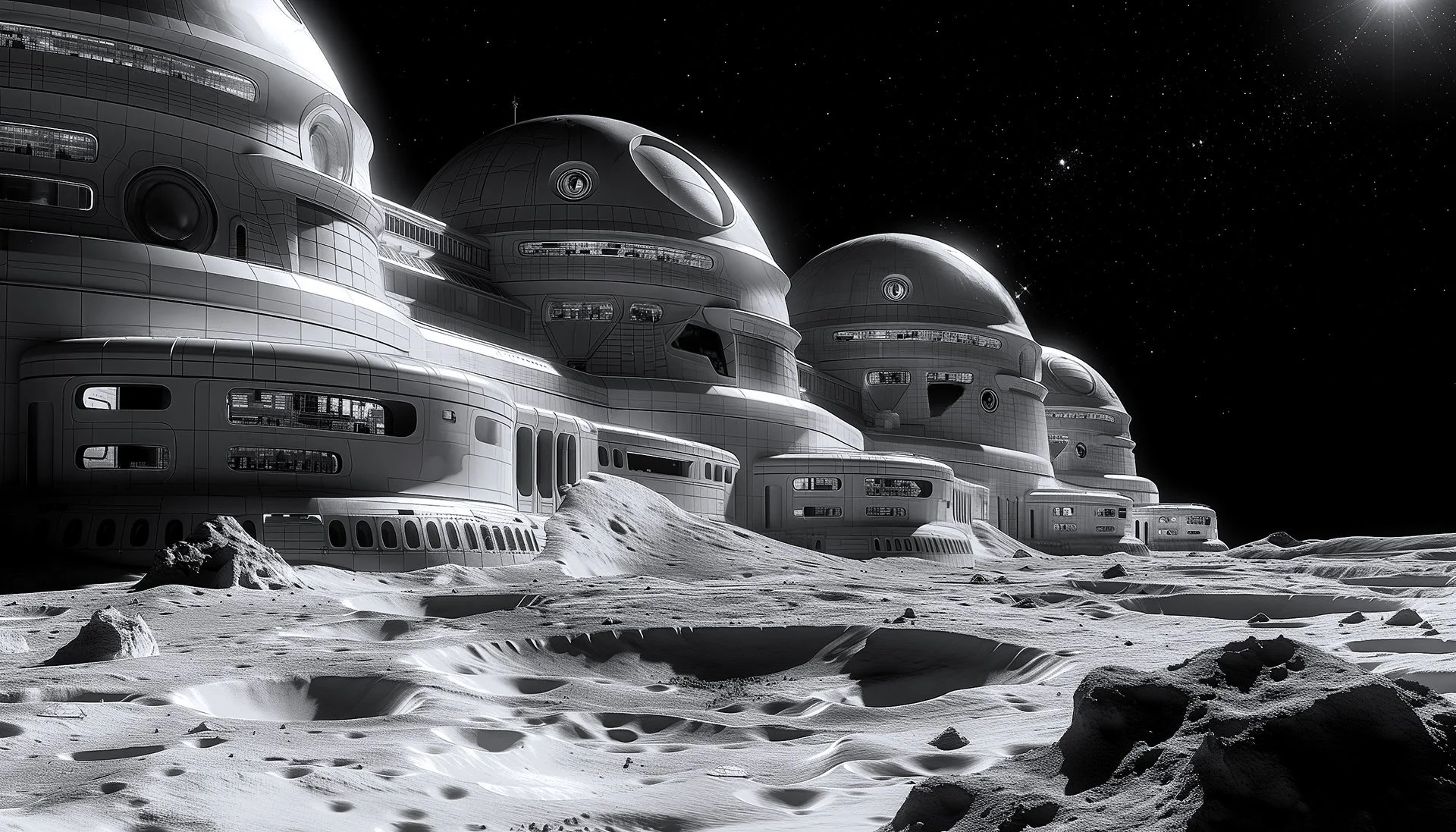
Located near the strategically significant Shackleton Crater, known for its perpetual sunlight on the crater rim and water ice reserves in its permanently shadowed regions, Capital City is the American Government complex & living spaces for America's governance extended to the lunar frontier.
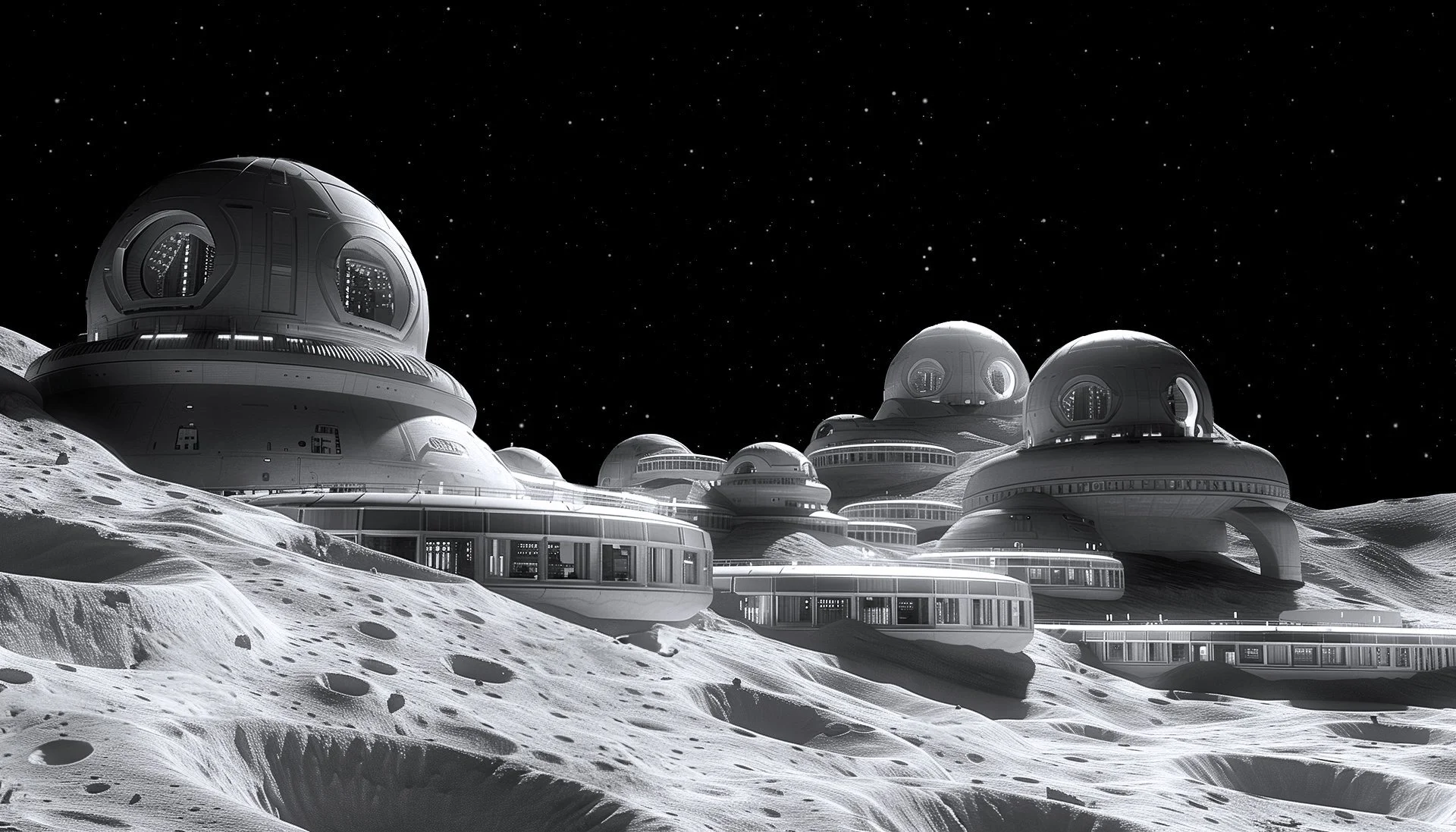
The community residences and common areas (shown below on the right) in Capital City are marvels of architectural ingenuity and adaptability, designed to accommodate the unique challenges and opportunities of lunar living. The exteriors are constructed from a composite material derived from lunar regolith, processed on-site to create a sturdy, radiation-resistant façade that mirrors the rugged beauty of the lunar surface. Inside, these residences balance functionality with comfort, incorporating Earth-like environments to ease the psychological strain of off-world living. Advanced life support systems ensure a constant supply of air and water, while hydroponic gardens provide fresh produce, contributing to the residents' diet and well-being. State-of-the-art communication systems keep the lunar officials in constant contact with Earth, ensuring seamless governance and decision-making across the vast expanse of space.
Capital City — Shackleton Crater, Surface Diplomatic Suites: Early-1950s


Tycho City — Tycho Crater, Lunar Residence Apartment Complexes: Early-1960s
As the colonies began to grow & flourish, towering structures were erected to house the thousands of colony workers, spaceport personal, maintenance crews, scientists, engineers, medical staff, botanists, and other personnel & citizens. The architecture blends advanced materials, capable of withstanding extreme temperature variations and shielding inhabitants from cosmic radiation, with design principles aimed at fostering community and well-being. These buildings are more than mere shelters; they are vibrant hubs of human activity, standing as beacons of humanity's adaptability and ambition. Inside, the environment is meticulously regulated, with artificial gravity systems to emulate Earth-like conditions and prevent the health issues associated with long-term weightlessness. The air is recycled and purified, while water is carefully conserved and reused through advanced life support systems. Artificial lighting mimics the natural diurnal cycle, providing a semblance of Earth's day and night to help maintain the psychological well-being of the residents.


Colony Support buildings & facilities
The importance of lunar colony support facilities extends beyond mere survival; they are critical for ensuring the colony's growth, sustainability, and the well-being of its inhabitants. Such facilities would address a broad spectrum of needs, from basic life support to advanced hydroponic food production, making the lunar environment not just habitable but thriving. Each colony has a series of support facilities at their disposal.


Space suits + Equipment
Space suits have evolved far beyond their original designs and purposes. They are no longer just utilitarian gear designed solely for survival in the harsh environments of space. Instead, they have become symbols of identity, fashion, and culture for the inhabitants of lunar colonies. The transformation began as humanity established permanent settlements on the Moon, and the demand for space suits that could accommodate a wide range of activities and personal expressions increased. Recognizing the opportunity, some of the top designers from America and around the world turned their attention to space wear. These designers, renowned for their contributions to haute couture and ready-to-wear on Earth, brought a fresh perspective to the engineering-dominated space apparel industry.
The use of advanced materials and technology has made it possible to incorporate a wide range of colors without compromising the suit's integrity or the wearer's safety. These materials are designed to withstand the extreme conditions of space, including radiation, vacuum, and the abrasive lunar dust, while also allowing for vibrant and long-lasting colors.


PETS IN SPACE
Recognizing the importance of companionship and the bond between humans and their pets, engineers and designers have developed specialized space suits for dogs and cats living in the lunar colonies. This development marks a significant leap in making life on other planets more like Earth, where pets are an integral part of many families. These specialized suits are designed with the safety, comfort, and mobility of pets in mind, allowing them to accompany their owners on extravehicular activities (EVAs) or simply enjoy the lunar habitat in safety. The suits are equipped with advanced life support systems that regulate temperature, provide breathable air, and manage waste, ensuring that pets can survive the harsh conditions outside the lunar bases.


LUNAR JETPACKS
Lunar jetpacks propelled by hydrogen fuel cells represent a groundbreaking leap in Lunar mobility. These advanced propulsion systems harness the power of hydrogen, a readily available resource on the moon thanks to the Lunar polar ice, to generate thrust, enabling astronauts & Lunar citizens to maneuver effortlessly across the lunar surface.


Advanced PLSS (Portable Life Support System) packs
The evolution of Personal Life Support Systems (PLSS) continues to push boundaries, catering to the demanding environments astronauts and Lunar citizens encounter beyond Earth's atmosphere. These advanced PLSS seamlessly integrate cutting-edge technologies to enhance safety, comfort, and efficiency during extravehicular activities (EVAs). Equipped with smart sensors and AI algorithms, capable of continuously monitoring vital signs and environmental conditions in real-time, thereby providing immediate alerts and adaptive adjustments to ensure optimal performance and health. Furthermore, these next-generation PLSS incorporate advanced material science, featuring lightweight yet robust components, offering unprecedented durability and minimizing physical strain. Integration with augmented reality (AR) displays enhance situational awareness, providing intuitive navigation and task guidance.



Lunar Colony Robots
CONSTRUCTION ROBOTS
Construction robots played a pivotal role in the development and expansion of lunar colonies, leveraging cutting-edge technology to overcome the challenges posed by the harsh lunar environment. These mechs are specifically designed to withstand the extreme conditions of space while efficiently executing construction tasks with precision and speed. Equipped with advanced AI systems, these robots can operate autonomously or under remote supervision from Earth or a central control station on the lunar colony. They analyze construction plans, adapt to changing environmental conditions, and make real-time adjustments to ensure efficient construction progress. In larger construction projects, multiple robots may work together in a coordinated manner, leveraging swarm robotics principles to divide tasks efficiently and optimize construction timelines. This collaborative approach enables rapid progress in building essential infrastructure for the lunar colony, such as habitats, power stations, and research facilities.
SeleneX Lunar Construction Bots: Mid-1960s Models


NeXterra Lunar Construction Bots: Late-1960s Models


MAINTENANCE BOTS
In the Late-1960s, the maintenance robots play a crucial role in ensuring the smooth operation and sustainability of the established lunar colonies. These robots, often referred to as "Maintainers," are designed to operate in the challenging conditions of the Moon, and are integral to the fabric of lunar society. The Maintainers are designed with versatility in mind, equipped with a suite of tools and sensors to perform a wide range of tasks. They continuously monitor the structural integrity of the colony's buildings, airlocks, and domes, using sophisticated sensors to detect cracks, leaks, or any signs of wear and tear. When damage is detected, repair units are dispatched immediately to address the issue, utilizing welding tools, sealants, or replacement materials processed from lunar regolith. Maintainers oversee the habitat's life support systems, including air filtration, water recycling, and temperature regulation. They perform regular maintenance on these systems and are equipped to repair or replace components as needed, ensuring a constant, comfortable environment for the colony's residents.
LUNARCORE SERIES


ARGONAUT SERIES



MEDICAL BOTS
In the bustling lunar colony, Medical Bots are indispensable members of the community, tirelessly serving the diverse needs of its citizens. These sleek, humanoid machines glide through the colony's corridors with graceful efficiency, their gentle demeanor putting residents at ease. Equipped with advanced medical sensors and AI algorithms, nurse bots provide round-the-clock healthcare support, from routine check-ups to emergency interventions. Their tireless dedication ensures prompt response to medical needs, even in the remotest corners of the colony. With their precise diagnostics and personalized care plans, Medical Bots play a crucial role in maintaining the health and well-being of the lunar populace, fostering a sense of security and trust in the colony's futuristic healthcare system.


ASTROBOTS
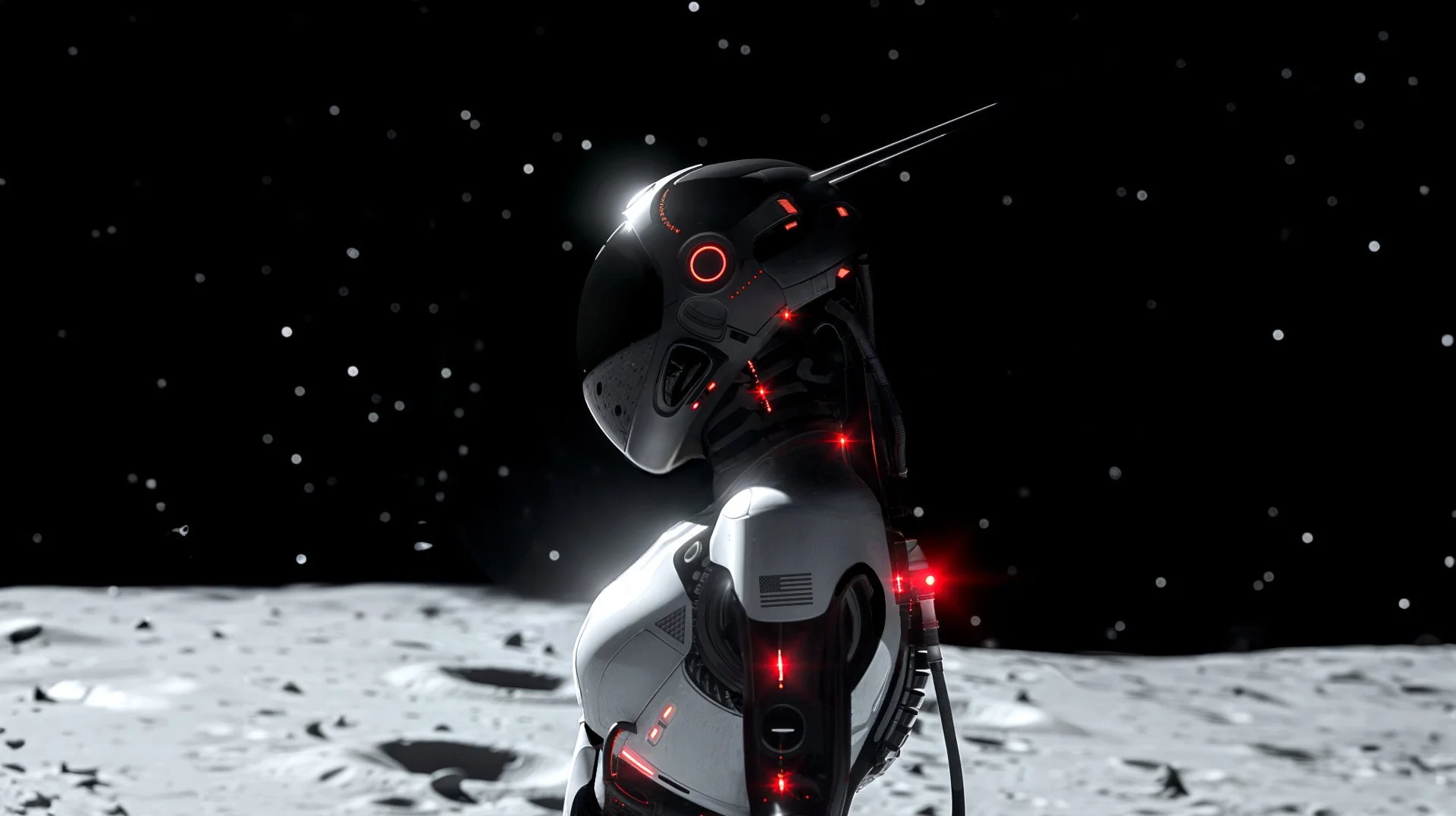
The Astrobot plays a crucial role in the smooth operation of the American lunar colony spaceports, performing a variety of job functions essential for maintaining infrastructure, facilitating transportation, ensuring safety, and supporting the needs of both incoming spacecraft and lunar colonists. Acting as a communication interface, the Astrobot relays messages between spacecraft crews, ground control, and lunar colony personnel. It provides information on arrivals, departures, weather conditions, and any other relevant updates. Utilizing its autonomous navigation capabilities, the Astrobot guides incoming spacecraft to designated landing zones within the spaceport. It ensures safe and efficient traffic flow, avoiding collisions and obstacles along the way.


Spaceports
Dealing with the constant comings and goings of rockets and spacecraft is a finely tuned ballet of precision engineering and rigorous protocols. The American lunar spaceports are equipped with multiple launch pads and landing sites, each designed to accommodate a variety of spacecraft, from sleek lunar shuttles to heavy Zeus cargo rockets and interplanetary vessels. The spaceports employ advanced traffic management systems that coordinate spacecraft arrivals and departures, ensuring safe distances and optimal trajectories.


The Lunar Vehicles of Tomorrow
Lunar Terrain VEHICLES
The lunar terrain vehicles typically feature sturdy yet lightweight construction, equipped with advanced suspension systems to navigate the Moon's uneven surface. Their tires are puncture-resistant in the rocky, low-gravity environments. Lunar cars boast an array of sophisticated instruments, including GPS systems adapted for lunar mapping, communication arrays for seamless interaction with Earth, and environmental sensors to monitor radiation levels and temperature fluctuations. Moreover, they often incorporate modular designs, allowing for easy customization and repair in the harsh lunar environment.
They are typically 3 times larger than their Earth-based counterparts to accommodate bulky space suits and their life pack or PLSS (Portable Life Support System) packs.
LunaDrive Systems LunaScout RS: Mid-1950s Models


LunaRover: X1000: Mid-1960s Models


LunaRover: X2 Long Range: Late-1960s Models


GMC Crater Jumper Series: Late-1960s Models


LunAR Flight Vehicles
Flight-based vehicles offer unparalleled mobility and efficiency for residents of a moon colony. Navigating the rugged lunar terrain can be slower and more challenging for ground vehicles, but flight-based ships can easily overcome these obstacles, providing swift transportation between different areas of the colony or for longest distances to more distant colonies.
MoonFlyer: Mid-1960s Models


Solaris Voyager: Late-1960s Models


The Vacation of Tomorrow
Lunar HOTELS
The Zero Seasons Hotels: Late-1960s
The Zero Seasons Hotels emerge as a leader of luxury and human ingenuity, catering to tourists and travelers seeking the ultimate extraterrestrial experience. These hotels, named to reflect the Moon's lack of Earth-like seasons, offer unparalleled accommodations, amenities, and experiences, all while embracing the unique challenges and opportunities of lunar hospitality. Like their Earthly counterparts, The Zero Seasons Hotels also offer hotel residences for those working and living on the Moon or looking for a second home.
Zero Seasons Hotels are masterpieces of architectural design, blending elegance with practicality in the lunar environment. Each hotel is constructed with a combination of ultra-strong transparent materials for windows that offer breathtaking views of the lunar landscape and the vastness of space, and regolith-based concrete for structures that require utmost protection from cosmic radiation and micrometeorites.


The Zero Seasons Hotels, Residences: Late-1960s
Residences and Hotel Guest rooms in the Zero Seasons Hotels are the epitome of comfort and luxury, with options ranging from standard suites to premium accommodations that include the latest in entertainmen. All rooms are equipped with adjustable gravity fields, allowing guests to choose their preferred level of gravity—a novelty that is as therapeutic as it is entertaining.


About the Journey to World of Tomorrow Science Fiction Series
Series Details
Timeframe: October 2023 to May 2024
Categories: RetroFuturistic, Science Fiction, Alternate Timeline, American Mid-Century
AI Artwork Images Generated: Over 11,000+ images, with the best selected for this Series.
Tools: Midjourney, Adobe Photoshop, a healthy dose of imagination (and patience) and way too much coffee.
Generative AI Artwork 3-part series
I was raised on a healthy diet of science fiction, from attending the Star Trek Lives! convention in 1973 at the Commodore Hotel in New York City with my Dad, to standing in line under the scorching MiamI sun in early summer of 1977 to witness the spectacle of Star Wars at the Dadeland Mall movie theater. Throughout my life, my entertainment has consistently revolved around the allure of future technology. As a child of the 1960s and 1970s, science fiction promised a lot of technology that never materialized. Where were the flying cars and trips to the moon, that flourished in science fiction literature and film? The Jetsons animated television series had flying cars appear on September 23, 1962 and Dick Tracy had his Air Car that appeared on August 30, 1964. The technological marvels were relegated to fiction never materializing in our reality. This alternate timeline series changes that.
There’s a lot of controversy surrounding generative AI artwork. Art is about expression. Any tool that can help you express yourself can be a good thing. There is also the notion that you just type a few words into a prompt and that’s it. If was that easy, this would not have taken me over a half a year to finish.
I used Midjourney to generate all the images in this 3-part series. The process was painstaking. It would take me hours to generate something specific i was after, then more hours generating enough content for that section that I felt was worthy of your viewing time and my effort. Once I had my base images, I then took them into Adobe Photoshop where I could spend as long as 5-6 hours removing visual anomalies that Midjourney ads to images using Photoshop’s generative fill tool. There has been images where i made over 200 changes and even rebuilt parts of the image. Then i would color correct the image and modify the lighting. I spent time creating mock ads & magazine covers. Some images were composite images. The television images you see in many cases use other generated images superimposed on the screens using Photoshop with lighting and glare effects added.
This was a labor of love & an exercise in imagination. I loved every single minute of it. So enjoy this trilogy. Sign up below to get an email when they’re released. Don’t worry, your contact information stays with us. We hate spam as much as you do.
Until next time!
Jeff
Founder & CEO of The Skins Factory