
AI, Dashboards, and Adaptive UI: Why the Hybrid Model Wins
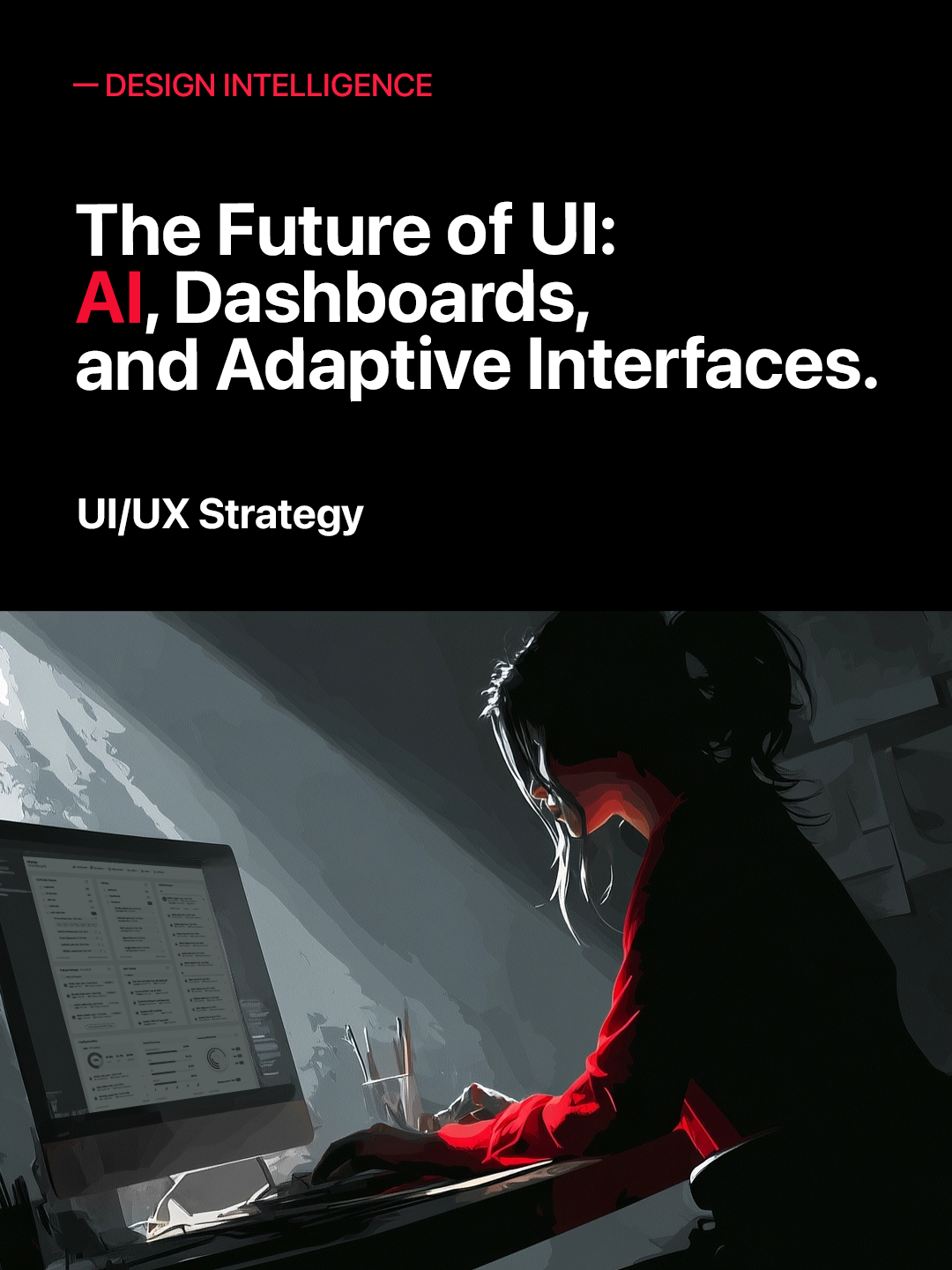
The Future of UI:
AI, Dashboards,and Adaptive Interfaces.
The interface isn't dead. It's evolving. For years, the prediction has been the same... AI will replace interfaces, dashboards will disappear, everything becomes a prompt. I'm not saying companies won't try, I'm saying users won't accept it. Interfaces will evolve into something far more powerful, a hybrid between structure & intelligence, and that shift will define the next generation of user experience design.

The Argument
Interfaces aren't going away. They're evolving into something more powerful, more dynamic, and more context-aware than anything we've seen before. The future of UI isn't no UI. It's a smarter, more adaptable UI.
Why Dashboards Still Matter — And Always Will
Dashboards exist for a reason: humans need visual overviews to make decisions quickly. A CFO doesn't want to ask "what's our revenue trend over the last six months?" They want to see it instantly. A product manager doesn't want to type a prompt like "show me user drop-off points." They want to see a visual funnel immediately. For the users who do want to query the system, there will absolutely be mechanisms in place to support that. What we're more likely to see, and what we at The Skins Factory will champion, is a hybrid model. Analytics will still be central to the experience, but users will also have the ability to surface information through prompts, including smart pre-filled prompts that make the system faster and easier to use. This "hybrid environment" will be why Design Systems will play a more important role than they have in the past.
The desktop environment is fundamentally different from mobile. People are far less inclined to "talk" to their computers in a work setting, especially in shared or professional environments. On mobile, voice and conversational input feel natural. At a desktop, users expect speed, precision, and visual clarity. That difference matters, and it's exactly why prompt-driven interfaces alone won't replace structured UI, they'll compliment it.
Reduced cognitive load. Pattern recognition at scale. The spatial and comparative analysis that no amount of text can replicate.
Visual hierarchy. Comparative analysis across datasets. The human instinct to scan and immediately grasp what's wrong - or right.
AI doesn't eliminate dashboards. It enhances them.
The Rise of AI as a Layer, Not a Replacement
The biggest misconception is that AI replaces UI. In reality, AI becomes a layer on top of the interface. UI provides structure. AI provides intelligence. Think of it as UI = Structure, AI = Intelligence. They work together - not in opposition.
What AI adds: natural language querying, predictive insights, automation of repetitive tasks, context-aware recommendations. Instead of replacing a dashboard, AI lets you ask "why did conversions drop last week?" and get a contextual breakdown tied directly to your visual data.
The interface remains. AI makes it smarter.
You ask: "Why did conversions drop last week?" You get a contextual breakdown tied directly to your visual data - not a blank text response.
Natural language querying surfaces answers without replacing the chart. The chart persists. It becomes smarter.
Repetitive workflows are automated. The decisions remain human. The interface facilitates - it does not dictate.
Static interfaces are the past & present
Adaptive interfaces are the very near future.
What Adaptive UI Actually Means
Traditional UI is static: same layout, same hierarchy, same experience for every user. The future is adaptive - interfaces that respond to user behavior, evolve based on context, and prioritize what matters right now for this person, in this role, at this moment.
Sees financial metrics first - revenue trend, burn rate, runway.
Sees engagement metrics first - activation, retention, drop-off.
Sees ticket volume, resolution time, and CSAT front and center.
Same product. Completely different interface. This isn't personalization as a feature. It's personalization as architecture - and it only works if the underlying design system is built for it. When AI adapts an interface in real time, it isn't inventing new components from scratch. It's drawing from a component library and falling back on a style guide to make decisions. Without that foundation, adaptive UI has nothing to work with. Design systems aren't just design tools anymore. They're the infrastructure that makes intelligent, adaptive interfaces possible. This is why the companies investing in design systems today are the ones who will be ready for what's coming.
Why Prompt-Only Interfaces Will Fail Alone
The idea that everything becomes a chat interface may sound appealing to some, but it would break down quickly. Users don't always know what to ask. There's no visual context, no persistent structure, and it's dramatically slower for repeated workflows. Imagine running a business entirely through prompts - every query manual, no visual overview, no quick scanning. To me, that sounds like a nightmare.
Replaces structure with prompting. Forces users to know what to ask. Loses the spatial intelligence of a visual layout entirely. Slower for every repeated workflow.
Preserves visual structure. Adds natural language as an enhancement layer. Users get both speed and depth - without having to choose between them.
The Hybrid Model: Where Everything Is Going
The winning model isn't a choice between AI and UI. It's a deliberate combination of both - layered with adaptive behavior. Together, this creates speed, flexibility, and intelligence. Separately, each falls short.
01
Visual Dashboard
For overview. Immediate pattern recognition. The at-a-glance layer that no amount of prompting can replicate.
02
AI Assistant
For exploration. Natural language queries that surface deeper insight without replacing the visual structure beneath.
03
Adaptive Layout
For personalization. The right interface for the right user - automatically. Not a feature. An architecture decision.
Most enterprise software today is cluttered, rigid, and painful to use. AI doesn't fix that by default. Bad UI plus AI equals a worse experience.
The opportunity is in the combination: clean, structured UI layered with AI intelligence and thoughtful adaptive behavior. This is where modern products will separate from legacy ones.

The Role of Design Is Becoming More Important, Not Less
There's a risky assumption that AI reduces the need for design. It does the opposite. More complexity requires more clarity. Adaptive systems require stronger underlying structure. AI outputs need thoughtful presentation - or they create confusion, not insight.
Poor design leads to confusing AI results, misinterpreted data, and broken user trust. Great UI/UX design enables confidence, speed, and better decision-making. The output of AI is only as useful as the interface presenting it.
Many interfaces will no longer be static. Every layout decision will now have downstream effects on how AI outputs are understood.
AI is no longer optional in enterprise product design. The question is how it's integrated, not whether. Every company will handle it differently, but few will ignore it.
Users will come to expect systems to think with them. That expectation lives or dies in the interface layer.
The future of UI isn't a blank screen with a prompt. It's a living system.
Clear visual hierarchy that humans can scan and act on instantly.
Interfaces that respond to role, behavior, and context in real time.
AI as a layer that enhances - not replaces - the interface beneath.
Designed for the people making decisions, not for the technology enabling them.
If your product feels outdated or hard to use, it's not a development problem.
It's a design problem. And fixing it changes everything - adoption, retention, conversion. Click below to complete our product inquiry form. In a rush? Use the quick form below, and we’ll take it from there.Have a project in mind? Let's chat.
Thank you for reaching out.
We will be in touch within one business day.AI UX Design Articles
In-depth guides on AI UX design, from copilots and AI agents to design systems and adaptive dashboards for B2B SaaS products from The Skins Factory.
For the full picture, see our AI & Agentic UI/UX Design Agency page.



About Jeff Schader
Jeff Schader is the founder and CEO of The Skins Factory, a UI/UX design studio he started in 2000, based in the Miami/Fort Lauderdale area. He has designed software for some of the biggest names in tech and entertainment, including Microsoft, Disney, the NFL, Bank of America, and Intel, along with SaaS, fintech, healthcare, cybersecurity, and enterprise platforms. Jeff runs The Skins Factory lean and stays hands-on across client work, strategy, and design. He writes about UI/UX, AI interfaces, and what actually makes software usable.
Have a project in mind? Schedule a 30-minute call with Jeff. Jeff also publishes The Product Design Insider on Substack.

Every software company is racing to add an AI Copilot. The feature ships, the demo looks magical, and then real users touch it and something falls apart. They don’t trust the output. They can’t tell when the AI is confident or when it’s guessing. The model was never the problem. The interface around it was.