Apple’s “New” Glassmorphism: A Shiny Retread of Windows Vista’s Legacy?
Apple’s rumored shift toward a glassmorphic design language, expected to debut in its next major OS update, is already generating buzz. With its translucent layers, subtle blurs, and frosted-glass aesthetics, glassmorphism is being heralded by some as a bold, fresh direction. But here’s the twist: we’ve been here before. Almost 2 decades before to be exact.

Glassmorphic UI Tests for the Intel Project Designed by The Skins Factory - Circa 2008
Let’s rewind to the mid-2000s.
When Microsoft launched Windows Vista in 2007, one of its most defining — and polarizing—UI features was “Aero Glass.” This design system was glassmorphism in its purest, earliest mainstream form: semi-transparent windows, glossy textures, and background blurs designed to mimic the look and feel of polished glass. The design language itself was a leap forward in interface aesthetics.
At the time, The Skins Factory was also setting trends in UI design - delivering, high-end skeuomorphic design. In 2007, we were hired by Intel Corporation to design a revolutionary new user interface for their Windows-based Graphics & Media Control Panel.
The Intel project would take 2 years to build. This was high-end glassmorphic design.
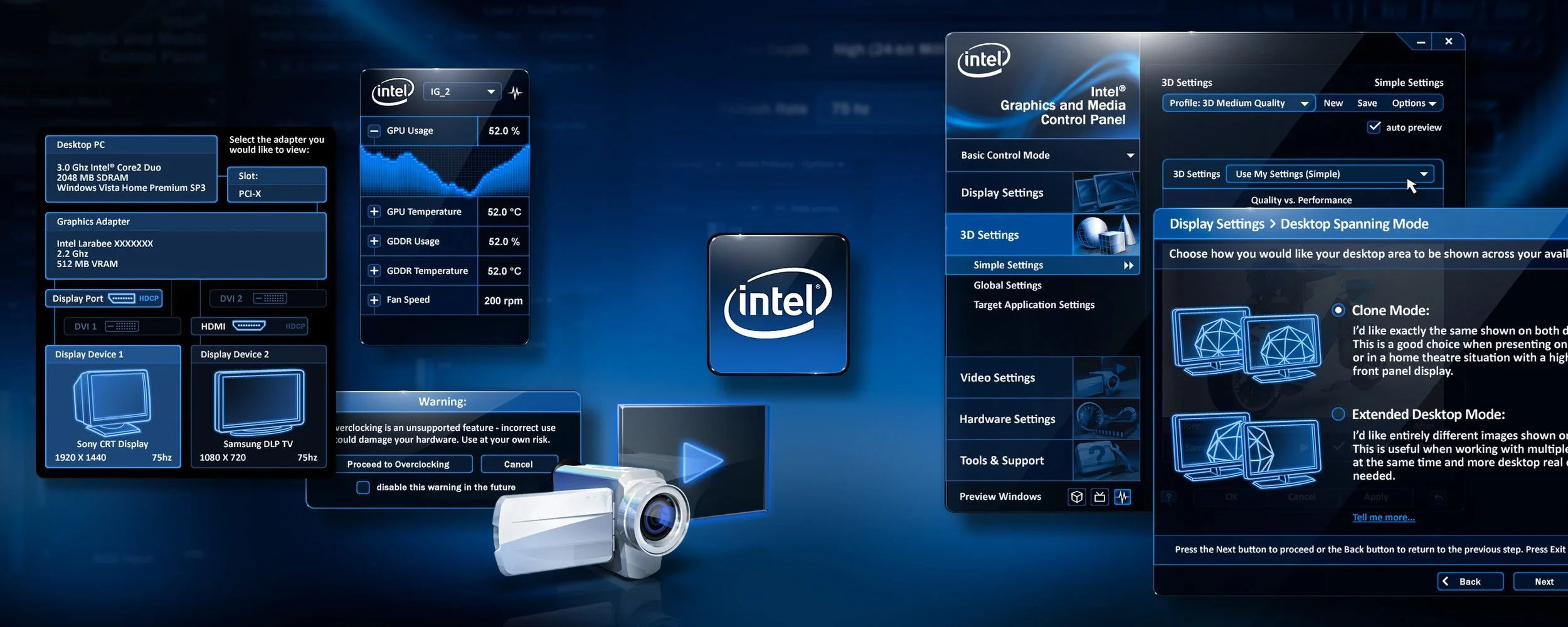
The Skins Factory's Intel Graphics & Media Control Panel design - Circa 2008.
A Legacy Apple is Now Polishing
Fast forward nearly two decades, and Apple appears poised to bring back these same principles — repackaged with Cupertino polish and based on their visionOS UI. The company has dipped its toes into translucent effects over the years, notably with macOS Big Sur and iOS 7, but what’s coming next looks to be an even deeper embrace of glassmorphism as a core UI identity.Yet, for those of us in the UI/UX design world who’ve lived through these cycles, it’s clear: Apple’s upcoming “innovation” is really a revival. And a welcome one.
This is the longest stretch in my 27-year career in UI design where the visual language has remained virtually unchanged. Ever since Jony Ive ushered in the era of flat, 2D design following Scott Forstall’s departure from Apple, we've been living in a minimalist world — since around 2013. That’s well over a decade, and frankly, the design world is long overdue for a shift.
At The Skins Factory, we’ve never waited for trends to tell us what’s next. We’ve been reintroducing tactility into our interfaces for years — leaning into subtle depth and nuance through carefully applied neumorphic techniques. So it’s refreshing to see the industry begin to embrace the elegance of dimensionality once again. The return of glassmorphism isn’t just nostalgic — it’s a reminder that great design is as much about feel as it is about function.
The Skins Factory: Ahead of the Curve Since Day One
At The Skins Factory, we’ve always understood that UI design is cyclical. But rather than chase trends, we set them. If you go way back into our portfolio, you'll find designs that were far ahead of their time.
Back in the early 2000s — yes, even before Windows Vista—we were already experimenting with semi-transparent interfaces, layering, depth, and lighting effects that would later be categorized as glassmorphism. Our studio’s work with tech giants like Microsoft, NVIDIA, and Warner Bros. was rooted in bold visual storytelling — often exploring what was then considered bleeding-edge.
Our interfaces weren’t just stylish — they were strategic, intuitive, and ahead of their time.
Why This Matters Now
As Apple steps into the glassmorphic spotlight, it’s a good time to remember that truly visionary design doesn’t just follow aesthetic waves — it helps shape them. And while Big Tech might have the stage, it’s often smaller, more agile studios like The Skins Factory that do the creative heavy lifting long before the spotlight catches on.
Design isn’t about who does it first. It’s about who does it right. And if glassmorphism is finally having its moment in the sun (once again), we couldn't be happier.
If you're ready to take your software application's design to the next level, contact us.
About The Skins Factory
For more than 25 years, The Skins Factory has offered world-class UI/UX design services, specializing in creating intuitive, user-centric application designs that enhance usability and foster engagement. With expertise across web applications, mobile apps, and desktop client applications, we integrate cutting-edge aesthetics with superior user experiences. Our approach consistently drives innovation, setting industry benchmarks and elevating client projects to new heights.
We believe that great design knows no boundaries, ensuring that every voice is heard and every vision is realized.
Have a project in mind? Let's talk.
Thank you for reaching out.
We will be in touch within one business day.
About Jeff Schader
Jeff Schader is the founder and CEO of The Skins Factory, a UI/UX design studio he started in 2000, based in the Miami/Fort Lauderdale area. He has designed software for some of the biggest names in tech and entertainment, including Microsoft, Disney, the NFL, Bank of America, and Intel, along with SaaS, fintech, healthcare, cybersecurity, and enterprise platforms. Jeff runs The Skins Factory lean and stays hands-on across client work, strategy, and design. He writes about UI/UX, AI interfaces, and what actually makes software usable.
Have a project in mind? Schedule a 30-minute call with Jeff. Jeff also publishes The Product Design Insider on Substack.